
Have you ever considered where metal shavings or used PPE from our offshore operations end up? Or where waste from lunch ends up? We in TotalEnergies Denmark have and are closely following all of our waste streams.
TotalEnergies is committed to circularity and resource efficiency, developing recovery channels for waste from our sites. Improving waste circularity is crucial to reducing our environmental footprint and meeting our sustainability goals.
However, there is more to waste. Through its often several life cycles, it can be of value to both us and society – but it can also be challenging to sort correctly.
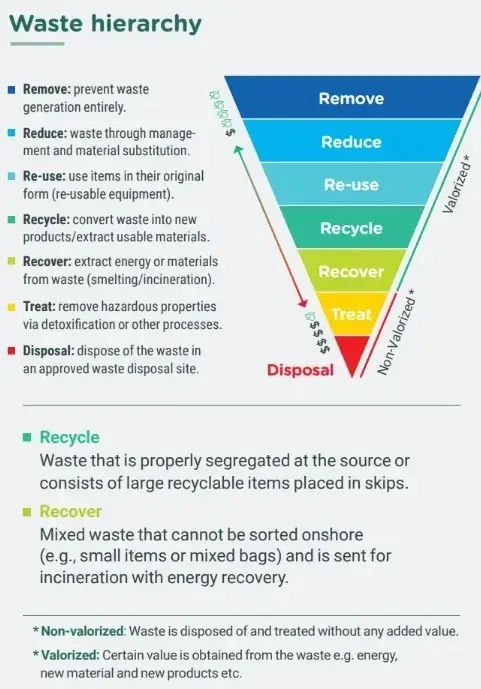
The waste hierarchy ranks waste management options from most to least sustainable: prevent, reuse, recycle, recover energy, and dispose. Following this order reduces environmental impact, preserves resources and maximizes value from waste - benefiting both society and the business.
Feedback driving improvement
To understand how waste is sorted offshore, and how we can maximize its valorization potential, we have dug deep in the skips to understand our waste.
At TotalEnergies Denmark we were valorizing nearly 99% of our waste, but most of it was via energy recovery. Which meant - there is room for improvement.
Since 2023, TotalEnergies Denmark has evolved waste sorting from an onshore driven initiative to a tailored and locally anchored practice offshore, which has increased ownership and shaped life on the platforms themselves.
This approach accommodates the different reality which offshore platforms operate in, with limited space, complex logistics, and varying operational setups. A remote installation 250 kilometers from shore, for example, does not have the same possibilities for waste skips, sorting bins or storage as onshore facilities.
Open dialogue with offshore teams is central to improving waste practices. Recurring questions and challenges led to the establishment of monthly Offshore Waste Forum, where issues are discussed and solutions shared across platforms.
“Over the past year, each installation has assumed much greater responsibility for waste management. Several platforms, initially driven by the Halfdan B platform team, have developed their own local awareness initiatives. This has strengthened engagement and accountability – and 2025 is now our best year ever for waste recycling.” - Katrina Povidisa-Delefosse, Senior Environment Advisor.

Local ownership, local solutions
These differences underline the importance of flexibility within TotalEnergies E&P Denmark’s waste management framework, coordinated by the Health, Safety, Sustainability and Environment (HSSE) department, allowing platforms to adapt solutions to local conditions while meeting common requirements. Close collaboration with our waste management partner Stena Recycling has also been crucial to this development, as the waste analysis they facilitated for us in early 2024 has shaped the backbone of our adjusted waste management strategy.
Over the past two years, HSSE’s Environment team has invested heavily in improving our waste sorting performance. The results are clear: our recycled waste rate increased from 44% in 2024 to 59% in 2025, exceeding the target of 55%.
What happens to waste once it is back on land?
Waste is sorted offshore as far as space and regulations allow, then shipped to shore in skips. Most waste is handled by Stena Recycling, where it is further sorted into the appropriate fractions.
Offshore metal waste, for example, is processed in Esbjerg and Grenaa before being recycled into new products for other industries. At TotalEnergies E&P Denmark, 99% of waste is valorized — recycled, reused or used for energy recovery, i.e., converted into heat and electricity for homes and industry.
How we continue to improve our processes
Regular audits and spot checks support continuous improvement through dialogue, not control. These include platform visits, observation of waste handling, and follow‑up using internal tools where needed. Improvements range from shared containers to safer waste handling, reducing both risk and cost.
TotalEnergies E&P Denmark aims to recycle 60% of waste in 2026, increasing to 65% in 2027 and 70% in 2028. Continued collaboration, local ownership and open dialogue will be key to sustaining progress and further strengthening offshore waste management.
These changes reflect the ongoing growth in maturity in waste management, strongly anchored in the regulatory framework, both onshore and offshore, showcasing our strong, shared commitment to continuous improvement.